



Putting on the style
Big is better
A bottle of champagne only contains about 6 glassfuls, so it doesn’t need many people to finish the bottle. If you’re throwing a party you’re going to need a lot more than 1 lonely bottle, so why not buy magnums instead?
A magnum is a double bottle and although it’s usually a little bit more expensive than buying 2 bottles, there are a couple of very good reasons to go for magnums:
First there’s the wine itself.
Part of the ageing process for champagne involves the interaction between the air in the neck of the bottle and the wine that fills most of the bottle.
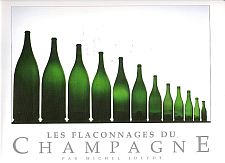 In a magnum you have twice as much liquid as in a bottle but only a little bit more air, so the whole ageing process is slowed down.
That means magnums spend longer in the champagne-maker’s cellar and this extra ageing means the flavours and aromas are always that little bit richer, rounder and more complex – try it and I’m sure you’ll notice the difference.
Second, magnums look so much more impressive and will really add a bit of fun and elegance to your party. I guarantee that the slight extra cost of magnums is well worth it.
Which glasses?
There are two reasons for choosing champagne glasses:
A real wine fan might say you that you should have glasses that are the right size and shape to enhance the champagne.
If that’s you, then go for the tulip-shaped champagne glass called a flute: tall, tapering in at the top, but not too narrow (if it’s too narrow you can’t move the champagne around in the glass to release the aromas)

Not the pefect shape but they certainly look lovely
The other very good reason to choose a champagne glass is because you like the look of it, in which case go for whatever you want, including perhaps the old-fashioned saucer-shaped glass called a coupe.
These are not so good for appreciating the finer points of the champagne, but for certain occasions and a bit of fun they’re great. They are also just right for champagne cocktails – one sugar cube with a drop of two of angostura bitters dripped into it, a good measure of brandy or cognac and topped up with champagne – a soft, sweet and silent killer of a cocktail and still hard to beat.
Next two more simple tips taken from the best soirées in Champagne.
Always hold your glass by the stem – why?
- That’s what the stem is for
- It looks more elegant
- The warmth of your hand doesn’t warm the champagne
- You don’t cover up the colour and the bubbles in the champagne
If you’re throwing a party, try to avoid pouring a tray of glasses and leaving it for your guests to take a glass as they arrive.
- The champagne will soon warm up
- The fizz will soon die down
- Part of the fun of champagne is seeing the bubbles rise up in the galls as it is poured in front of your eyes.
Serving
Last but not least, there’s lots of advice out there about the best temperature to serve wine, and champagne is no exception. The trouble is unless you happen to have a thermometer in your handbag or wallet – I don’t think so – simply knowing the ideal temperature is not much help. So here’s something a little more practical.
Put the bottle in an ice bucket with ice and half toped up with water, for about 20 minutes. This will get your bottle to the perfect temperature, which incidentally is 80 – 100 C for non vintage champagne (46-50 F). It’s a couple of degrees warmer for older vintage champagne, so 15 minutes in the ice bucket will be fine.
By the way, you can keep champagne in the fridge for weeks without harming it, but the fridge is at about 40 C (4 F) so take the bottle out 10 minutes before opening it.
Ringing the changes
Now it’s time to choose the champagne?
Champagne is the perfect aperitif but there are dozens of different styles of champagne so what not serve several different champagnes as the meal / evening / party progresses?
A useful anecdote about serving wine with a meal is
- start with white and go to red,
- start with dry and move to sweet and
- start with young and move to old.
The same sequence works for champagne dinners and for parties too. Here’s what I mean:
To start
Blanc de Blancs champagne is made only with Chardonnay grapes, so it’s crisp, dry and clean; fresh and citrussy, although a good one will still be smooth and soft in the mouth. The secret is that a couple of glasses of Blanc de Blancs will wake up your taste buds ready for the food to follow.
Next
As the party, or meal, progresses your palate will change too and a really dry wine or champagne will soon start to seem a little astringent – time for a change
A classic non-vintage champagne contains both white grapes (Chardonnay) and black grapes ( Pinot Noir and / or Pinot Meunier) The black grapes lend more fruitiness and fullness to the champagne, leaving a deliciously full and satisfying flavour in your mouth.
 After that it’s might be time for vintage champagne. You’ll find that vintage champagne is terrific with turkey, game and lots more besides.
Vintage champagne is aged for many years before being sold and this allows it to develop those lovely buttery, biscuity and toasty aromas. Gorgeous stuff... and if your budget runs to it I can’t think of anything better than to carry on drinking vintage champagne until the party’s over.
But if the budget won’t quite stretch to vintage champagne here’s another great idea.
Try demi-sec champagne. It’s delicious with many desserts and it’s oh-so-easy to drink.
Many people immediately say that they don’t like sweet champagne – even before they’ve tried it. But it’s worth discovering and believe me, lots of people who were really sceptical at first change their mind after actually tasting demi-sec.
When you take the first sip it does taste a little on the sweet side, but then take a mouthful of dessert and taste the demi-sec again – all the sweetness has disappeared and you’re left with the luscious texture of the champagne and the taste of honey, apricots and other candied fruits, all that with the typical freshness and fizz of champagne.
The best thing about demi-sec is that you can carry on drinking it until the cows come home. It has none of the bitterness that brut has after a few glasses and as the party, or dinner, comes to a close it’s demi-sec that gets my vote.
Whatever champagne you choose, have a wonderfu Christmas and an amazing New Year
