




CHAMPAGNE BULLETIN FEBRUARY 2023
SUPPLY CHAIN WOES
 The disruption to supply chains caused primarily by government policies in recent years in response to energy and health-related issues, is not showing any sign of improvement, if anything the situation is getting worse.
The latest problems relate to the supply of glass bottles which are a fundamental requirement for wine makers all over the world and France is no exception.
The issue is at the forefront of winemakers’ minds at the moment because this is the time of year when many wine makers are bottling the wine from the 2022 vintage.
According to a report in The Drinks Business, the problem started when many furnaces were forced to reduce production levels during the CVD episode. Today the problem is different but no less severe. It is caused by rocketing energy prices which, according to the report, have gone up by as much as four times over the past couple of years with the result that glass makers have again scaled back production.
Some bottles are no longer being made and others are in very short supply- clear glass for example.
For some types of wine there are alternatives such as cans and, in some cases, paper cartons, but these options are not possible for champagne because of the pressure that the bottles need to withstand and also because of the prestige presentation that consumers expect from a bottle of champagne.
It is not yet clear when and how these supply constraints will ease but ease they must if supply is to keep up with the buoyant demand from around the world.
SUPPLY AND DEMAND IN CHAMPAGNE
The principles of supply and demand are well-known and widely accepted: roughly speaking if supply goes up and demand remains stable, the price will fall. Conversely, if demand goes up and supply remains the same, the price must increase.
To put today’s situation into context it’s interesting to take a look at some data about how these two parameters have evolved in Champagne over the past half century or so. First let’s examine the supply as represented by the area planted with vines in the Appellation Champagne.
According to statistics from the Comité Champagne, back in the 1950s there were only some 12,000 hectares planted with vines. For the next 60 years or so the area under vine has been on a constant and rapid upward trend reaching 30,000 + hectares around 2010: an increase of almost three times.
Since 2010 there has been very little change because we are almost at the limit of the total 34,200 hectares authorised in the appellation - a total which is more theoretical than attainable since there are always a significant number of hectares lying fallow for a year or two to allow the soil to recover after old vines have been uprooted.
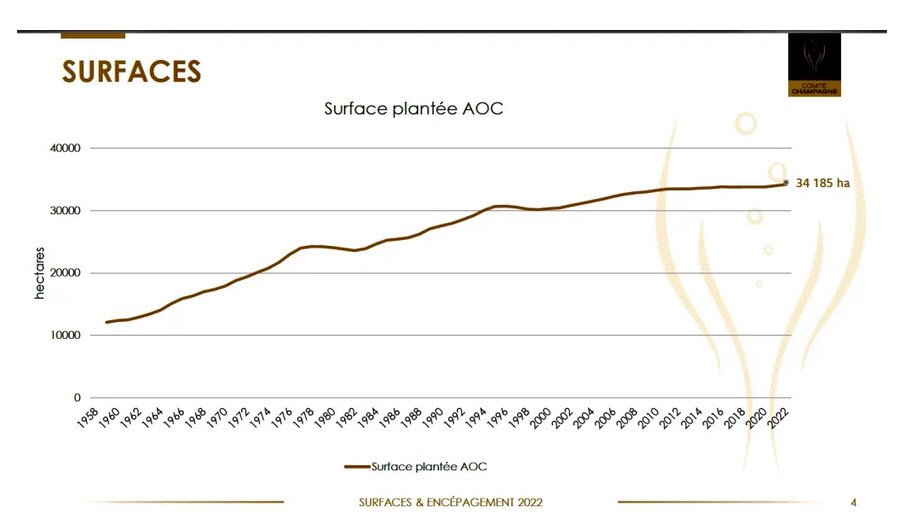
In this context one might expect the price of champagne to have fallen in the same proportion as the increase in supply, but other factors are at play; although the area under cultivation has increased, the yield in terms of the quantity of grapes harvested ( called the rendement) has not followed the same pattern.
As the chart below shows, there was approximately a threefold increase in the rendement between 1950 and about 2010, but from then to the present day the rendement has decreased.
The brown line shows the yield each year and the black line shows the 10 year average
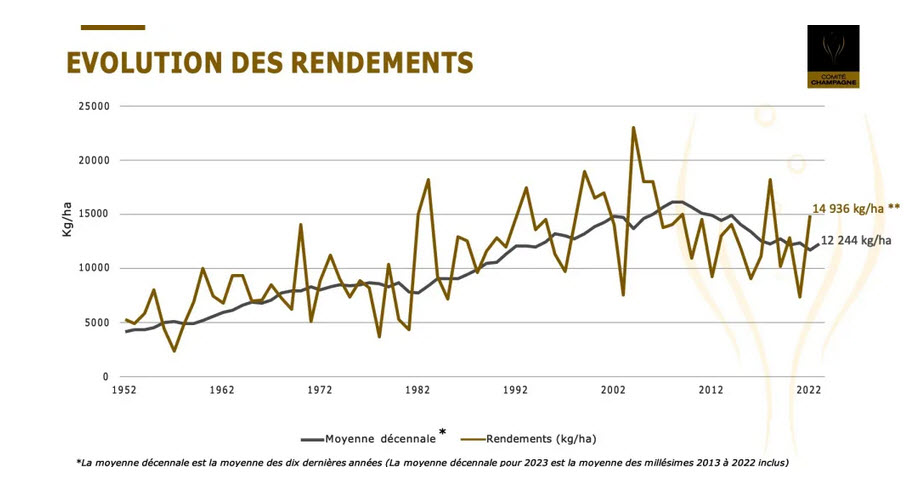
The recent decrease is due to a number of factors amongst which are an awareness that preserving the health of the soil is not compatible with ever-increasing yields, and a greater focus on the quality of the grapes rather than solely on the quantity. These considerations have led to a deliberate reduction in the amount of fertilizer used resulting in fewer grapes per square metre and a reduced weight per bunch.
This then, is a second factor at play in the supply side of the equation. Let’s now look at demand.
In this chart you can’t see the exact numbers involved but the inexorable increase in sales is obvious despite the occasional blip along the way. (source: Comité Champagne)
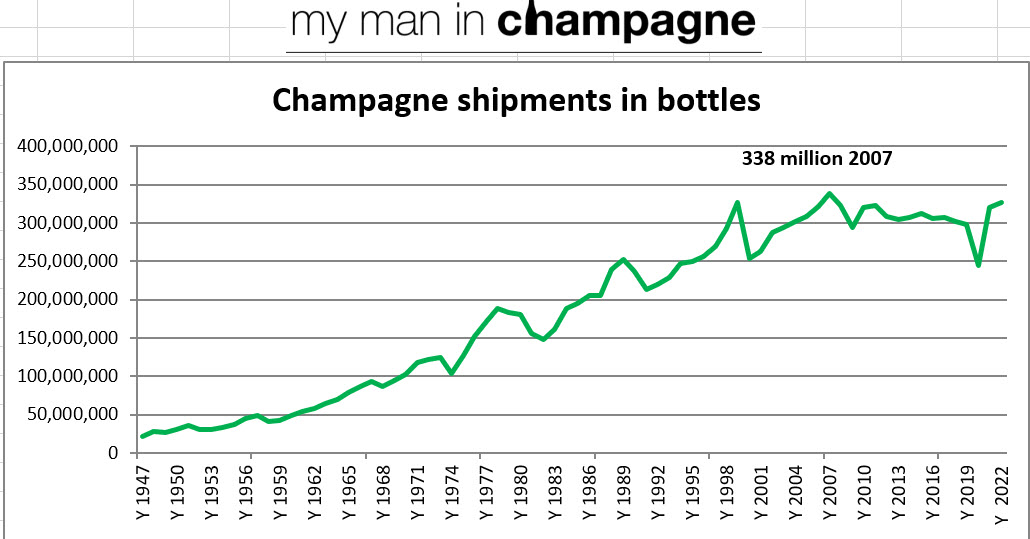
Sales in 1947 were just 21.5 million bottles
By 1956 they had more than doubled to 44 million
By 1967 they had doubled again to 93 million bottles and from then on things really took off
100 million bottles by 1970
200 million bottles in 1986
300 million in 1999 and since then sales have settled at around 310 million bottles + in years that are not disrupted by one crisis or another.
I’ll leave you to do the maths, but that’s a pretty impressive percentage increase – far greater than the increase in supply - and it’s fairly constant over the long-term making champagne a very attractive business to be in.
To summarise, demand has more than kept pace with the increase in supply and over the past two years the strength of that demand has increased yet again with the inevitable result that prices are firming up considerably as is evidenced by the fact that the total ex cellars value of sales exceeded 6 billion euros for the first time in 2022 – of course, at consumer level the figure is much higher still.
Added to this is the fact that the area of the Appellation Champagne is limited and even if a decision is taken one day to increase the area, that increase is unlikely to be very substantial, so the argument for higher prices for champagne continues to look very persuasive.
WHAT OF THE FUTURE?
 Export sales are the driving force behind the increase in demand for champagne in recent years.
It was the case for many years that the French drank more champagne per year than the rest of the world put together – exports accounted for less than half total sales.
That situation reversed about a decade ago and since then a combination of factors has made the divide between domestic sales in France and exports all the more significant.
An increasing concern about alcohol abuse led to severe restrictions in France on advertising and promoting alcohol, and a decline in young people drinking wine has also had an impact.
Many voices complained that champagne has an old-fashioned image and was consumed mainly by older people. Whilst this may still be true statistically, a number of initiatives have been put in place to make champagne a drink to be enjoyed by a much wider audience both geographically and in terms of age group.
This, coupled with the increasing prosperity in many developing countries and the rise of a middle class with discretionary income and a desire to enjoy what they perceive as some of the luxuries of life, is what is driving the boom in export sales.
The first shipment figures for 2023 only confirm this trend. For the 12 month period up to January 2023 sales were buoyant at 327 million bottles with the majority of these being in export markets whilst in France sales were down 2% versus last year.
Looked at overall, the champagne story today seems to be repeating what has occurred over the past 70 years. It’s a story of inexorable growth punctuated by repeated crises which only goes to demonstrate the extraordinary resilience and appeal of champagne.
That's a thought worth raising a glass to - champagne of course.
Until next month
 Those of you have already had a discussion with me about your champagne brand project will have heard me say that the rules and regulations surrounding champagne are much more strict than you might imagine.
 In other news, Kylie Minogue, whose range of still wines and Prosecco is enjoying spectacular success, has suggested that she would be interested in launching a champagne brand., however this may be easier said than done, in the short term at least, due to the constraints in supply at the moment.
 The combination of strong demand for champagne and the limited supply makes for a classic Sellers’ Market and the prospect of significant profits to be made. This has not escaped the attention of many of the largest names in the world of wine.
 In previous Champagne Bulletins, I’ve often touched on the fact that stocks in Champagne are running low because of two consecutive small harvests in 2020 and 2021 followed by a large and unexpected increase in sales of champagne as many aspects of life returned to normal at the end of that pandemic.
 To add fuel to this fire, in a recent interview, Philippe Schaus, the head of Moët Hennessy – the wines and spirits branch of LVMH, the world’s largest luxury brands group - confirmed that he expects just the kind of shortages that have been feared.
 Whenever I work with a new client on a private brand, one of the first questions I ask is “ Who are your target customers?”
 In case you’ve never heard of Champagne Day, it started over a decade ago, as an online only event for champagne lovers who wanted to share their enthusiasm with like-minded people around the world. That’s still the central theme to the event, but now it has given rise to loads of spin-off events both on and off-line, to celebrate and share champagne and to get people talking about champagne
 This short phrase may strike you as a bit flippant, but there is a lot of wisdom contained in these few words and they underline the fact that in the champagne business, patience is not just a virtue, it’s an essential.


 On the other hand, they can be effective to raise funds for charitable causes. Two excellent examples of this type of use are the champagnes endorsed by Roger Daltry to support Teen Cancer America and more recently the champagne launched to support the Royal British Legion which is an organisation that supports armed forces veterans.
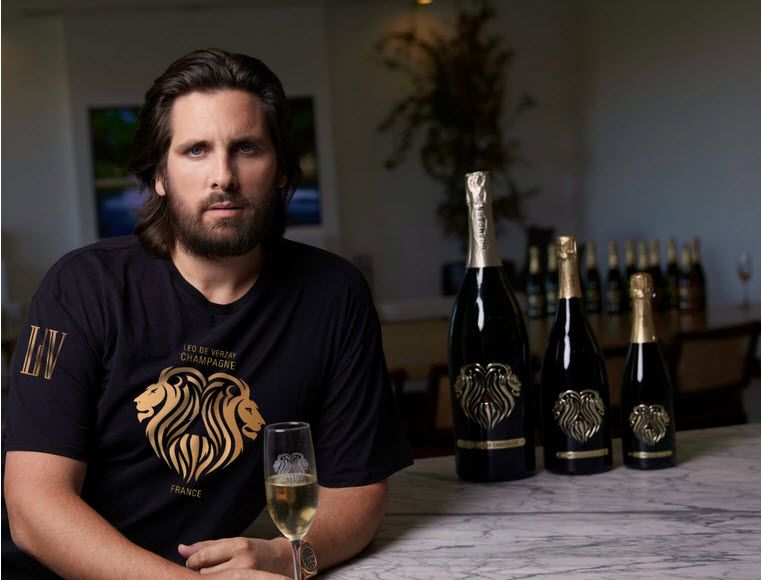 The first is another celebrity brand of the type seen over recent years across the whole spectrum of wine and spirits. In this instance it’s Scott Disick who is the personality behind the brand. For those of you who haven’t heard of Scott Disick ,he is the former partner of Kourtney Kardashian and regularly appears on TV in the US.
 It’s called Rendez-vous and has been launched under the brand name Diane Salem by co-founder Fiona Perrin, a French woman who has lived in the USA for many years.
 As mentioned above, lockdowns had a significant impact on DtC sales because for many months people couldn’t go out to their favourite bar or restaurant and instead ordered wine to enjoy at home, so as things get back to normal, we shouldn’t expect this fast rate of DtC sales growth to continue.