



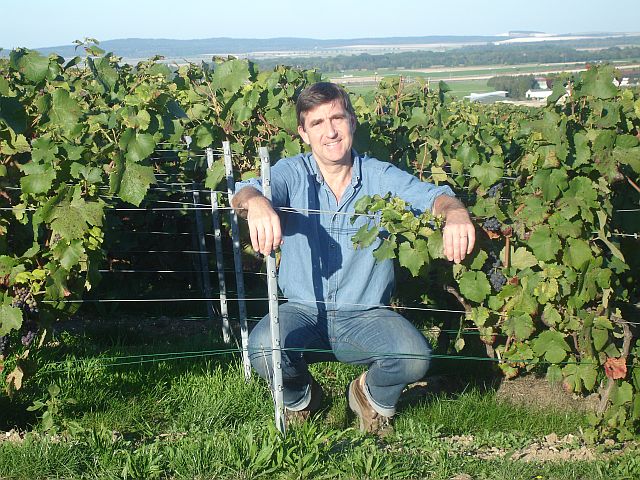
 In last week’s post I mentioned the Réseau Matu which is a network pf small teams of vignerons in selected villages that sample the grapes every few days in the run-up to the harvest so as to track the ripeness of the grapes and thereby to determine the start date of the harvest. In this bulletin you can discover more about the Réseau Matu and really get to understand why it is so important in planning the harvest.
August 9th 2015
 Not much is happening in the vineyards in Champagne at the moment because August is the month when many French people go on holiday and that includes champagne makers. As people head off for the beaches or mountains we’re entering the final 5 or 6 weeks before the harvest starts and the grapes are slowly ripening on the vines under the warm sun and we’ve had lots of it this year.
The heat hasn’t been as intense or prolonged as in 2003 when the grapes almost roasted on the vines, but it’s been a lovely summer with very little rain. The lack of rain is not ideal for growing grapes because rain is needed to plump up the grapes, so at the moment the grapes are looking a bit small and vignerons are keeping their fingers crossed that there’ll be a few more downpours in the coming weeks.
A month or so ago the general estimate was that picking would start around 15th September although this would vary from region to region and even from village to village, but if there’ s no break in the hot weather the start may well be as early as 10th.
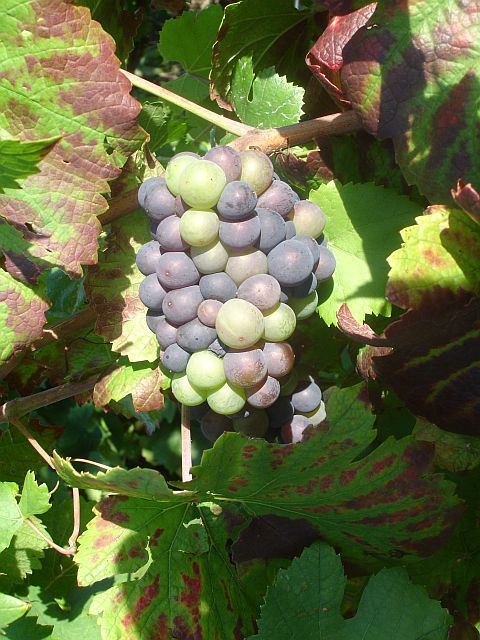 In a couple of weeks the black grapes will start turning colour – at the moment all the grapes, be they black or white varietals, are all green. The process of turning colour is called La Véraison.
Many people assume that days of hot, sunny weather must inevitably lead to a superb vintage, but that’s not necessarily the case. The sunshine certainly increases the sugar content of the grapes which is good, but the greatest vintage years are those when the sugar is perfectly balanced with a health level of acidity too; without enough acidity the resulting wine would be dull and uninteresting.
 To track the levels of both sugar and acidity over the coming weeks a system called the Réseau Matu, roughly meaning Maturity Watch, is put in place. A small group of vignerons chosen by each community will start weekly and then later, daily sampling of the grapes on the vines so that they can be analysed for sugar and acid content.
Ideally picking will be delayed as long as possible in order to get the perfect levels of both sugar and acidity. However this doesn’t happen every year; other factors such as the weather forecast and the health of the grapes on the vines have to be taken into account and sometimes the vignerons have to accept a less than perfect balance because to wait any longer would not bring any improvement and might take the grapes past their peak.
It a critical time of year when the result of all the work of the previous 12 months hangs in the balance.
PS
As I write it’s been raining steadily, but not violently, for 2 hours. Exactly what the doctor ordered.
 I was at a champagne tasting the other day. In fact it was me who had organised it on behalf of one of my clients – a champagne producer who wanted to get an independent evaluation of his champagnes.
 Mareuil-sur-Aÿ is one of just 2 villages in Champagne (out of 320) to be ranked as 99% on the former Echelle des Crus system, whilst its neighbour Aÿ, is a Grand Cru ( 100%).
 Back in the 1960s Patrick Forbes , one of the most respected wine journalists ever, particularly as regards champagne, wrote that the quality that was needed above all others to make wine in the northerly vineyards of Champagne was courage. Back in those days Champagne was still recovering from WWII and a vigneron’s life was, frankly, tough.