



VILLERS-MARMERY
 Driving south west from Reims along La Montagne de Reims you’ll pass through a cluster of Grand Cru villages recognised for the quality of their Pinot Noir, including three right next door to one another: Mailly-Champagne, Verzenay and Verzy. You’re in the heart of Pinot Noir territory and you might be forgiven for thinking that La Montagne de Reims is all about Pinot Noir and nothing else, but drive just 2 kilometres beyond Verzy and you’ll discover something quite different.
The village of Villers-Marmery: a sea of white grapes in an ocean of Pinot Noir.
Villers-Marmery is one of just four villages just at the tip of La Montagne de Reims, where it starts to curl westwards, that together form a small enclave where Chardonnay rules the roost. The other three villages are Trépail, Billy-Le-Grand and Vaudemanges.
Villers-Marmery Facts and Figures
246 hectares
242 hectares Chardonnay
4 hectares Pinot Noir
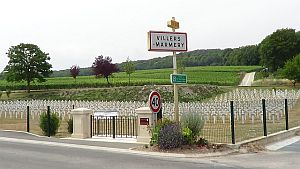 The first thing to notice as you enter the village is the WWI cemetery. Villers Marmery was just a kilometre or so from the front line during the war and the immaculately tended cemetery is a stark reminder of destructive visited upon this part of France.
If you leave your car and stroll into the vineyards you may notice that the soil in Villers-Marmery is more predominantly chalky than in the rest of La Montagne de Reims, so much so that in many places the chalk is right at the surface – you can pick chunks up from the ground and use it immediately to write with.
This is one of the reasons why this little area is so well-suited to Chardonnay and hence to making of elegant Blanc de Blancs champagnes which differ from the more full-bodied, powerful Pinot Noir driven champagnes you find in many other parts of La Montagne de Reims.
The second reason why Chardonnay is favoured in these four villages may be to do with the fact that that they are located right at the end of La Montagne de Reims at the point where the hillside curves round in a big arc towards the south and west. All four villages have exactly the same south-east exposure to the sun as La Côte des Blancs, further south, which is considered to be the home of the finest Chardonnay and Blanc de Blancs champagne
Take a look at the map below and you’ll see what we mean.
 The four villages of Villers-Marmery, Billy-Le-Grand, Trépail) and Vaudemange that make up this little enclave are circled in red.
The dotted red line shows the exposure of the vineyards and you can see that it’s exactly the same as La Côte des Blancs further down.
Up until the end of the Second World War the vineyards in and around Villers Marmery were planted with Pinot Noir just like the rest of La Montagne, but the results were less than spectacular. The villages were not considered good enough to warrant even Premier Cru status. However in the years after the war subsidies were being offered to encourage more Chardonnay to be planted and the change to Chardonnay was made. Whether this was for purely financial reasons, or whether it was a more reasoned decision based on the exposure of the vineyards, we cannot be sure. Be that as it may, in 1985 all 4 villages were elevated to Premier Cru status and classified as 95 % on the Echelle des Crus (now officially abandoned but still often referred to).
So what can you expect from the champagnes from Villers-Marmery and the other three villages?
Well, the best Blanc de Blancs champagnes from here are in no way inferior to those from La Côte des Bancs, they are just different. They have a similar light, bright, delicate style but whereas some people find that the steely intensity, the minerality and the pronounced freshness of some Chardonnay from La Cote des Blancs is too much for their taste, wines from Villers Marmery can be slightly fuller, softer and a little more fruity.
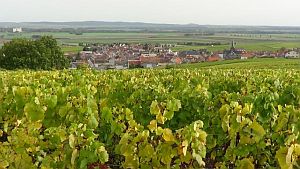 In fact the locals have even invented a word to describe their Chardonnay grapes. Pinoter which means to behave like Pinot Noir. I don’t think you’ll find this word in the official French dictionary, but when you hear the locals in Villers Mamery say that their Chardonnay grapes pinotent you’ll know what they mean.
Some of the producers already recognised for their quality are
A. Margaine and Henriet-Bazin both in Villers Marmey itself and David Léclapart a biodynamic producerin Trépail.
However in one way at least Villers Marmery is just like almost all Champagne villages you come across, you‘ll be amazed at just how many small champagne producers there are to discover and perhaps you’ll find your own personal favourites to add to this list.

 On the north facing slopes the grapes are fairly slow to ripen - the village is often amongst the last to start picking - and they undeniably have quite a high level of acidity; this results in wines with plenty of ageing potential that often need a few years to develop their full potential. There is also a slight saltiness to the wines which makes for some wonderful food pairings.
 Like many terroirs in Champagne you can find a multitude of different soils within the boundaries of the terroir of Verzenay: chalk, limestone, sand, clay and more. Not surprisingly therefore wines from Verzenay have great complexity, but whichever plot the wines come from they are all said to be vertical, linear and to have narrow shoulders as opposed to their cousins on the other side of La Montagne de Reims ( in Bouzy or Ambonnay for example) which are broader and fatter.
 On the other promontory, Mont Rizan, stands the lighthouse built in 1909 as a promotion idea for Champagne Goulet which no longer exists. Today the lighthouse is home to a popular museum and it affords some excellent views across the vineyards and the plain below.
 There’s something about Jean-Paul Hébrart that immediately puts you at ease. He comes across as serene and unruffled, well prepared and calm; the same could be said for his champagnes.
 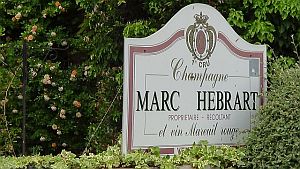 The vines are located in 10 villages, 5 of which are Grand Cru: Avize, Oiry and Chouilly in La Côte des Blancs provide Chardonnay and Aÿ and Louvois provide Pinot Noir.
 As if more evidence were needed of the quality of these champagnes I could cite the fact that Champagne Marc Hébrart is a member of both the exclusive Club Trésors de Champagne and also of Les Artisans de Champagne, another association whose members all have glowing reputations. However, when all is said and done, the best way is to judge for yourself and when you do I imagine that you will end up agreeing with Jean-Paul that a good wine needs no advertising.
 Most of the Chardonnay in this blend comes not, as you might assume, from la Côte des Blancs, but from the Hébrart vineyards in the more Pinot friendly village of Marueil-sur-Aÿ. As a result this is a wonderfully smooth champagne that sits effortlessly on the tongue. Yes, it has plenty of the freshness expected of a Blanc de Blancs and a light floral bouquet, but it also has a weight and a delightful presence in the mouth.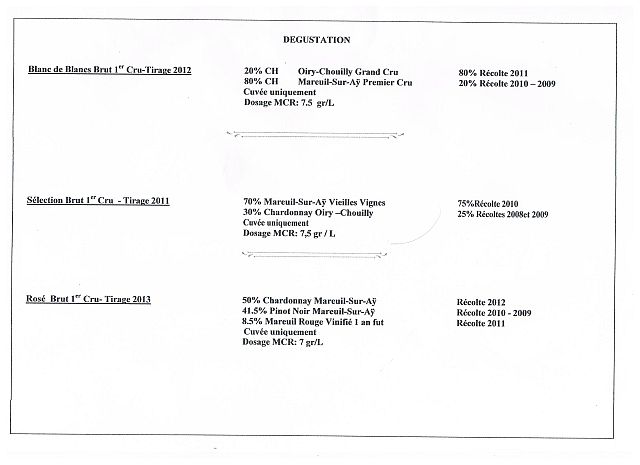
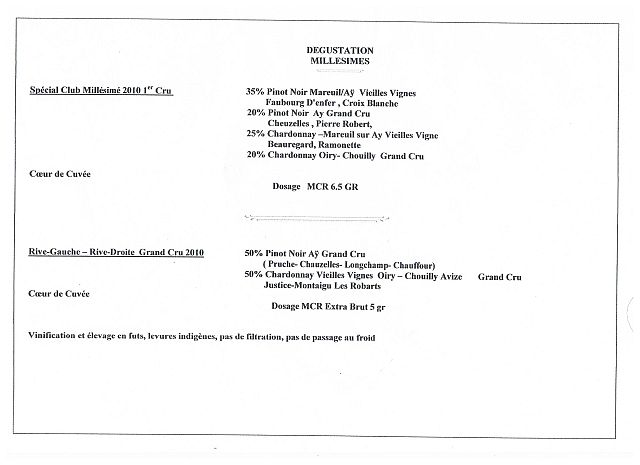

 Festigny is to be found in a small valley off the left bank of the Marne river approximately 20 kilometres from Epernay travelling down the Vallée de la Marne towards Château Thierry.
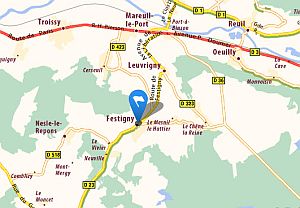 small village and the even smaller hamlets that make up this little enclave: Le Mesnil-le-Huttier, Beaurepaire, La Boulonnerie and Le Vivier Neuville.
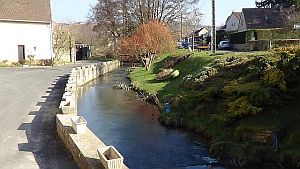 A wide variety of different soil types can be found here ranging from clay and marl to sand, limestone and chalk which
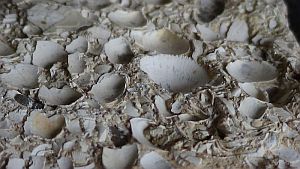 is full of fossils of the sea creatures that lived here many millions of years ago as you can often see by simply picking up a ump of chalk from the vineyards
  Festigny: Michel Loriot
 At this time of year a sort of rash appears in the champagne vineyards – a rash of white vans dotted all over the slopes as the vignerons hurry to finish pruning their vines before they really start growing again after their winter rest.
 Out come the white vans, the little rolling stools on which the workers sit as they work their way down the rows carefully pruning each and every plant, and the rusty old wheelbarrows in which the off-cuts are burned leaving tell-tale wisps of white smoke drifting across the rather barren looking vineyards (actually, ‘wheelbarrow ‘is rather a flattering term for these ‘brouettes’ which are little more than steel drums cut in two and fixed on a set of wheels).
 However where there is tradition and habit, entrepreneurial people can always find a new opportunity. A few years ago a young man by the name of Alexandre Hénin was struck not only by the tremendous waste of wood, but also by an idea for a new business: one for which the raw material would be free.